> For the complete documentation index, see [llms.txt](https://docs.opsnow.io/opsnow-user-guide-v0.2/llms.txt). Markdown versions of documentation pages are available by appending `.md` to page URLs; this page is available as [Markdown](https://docs.opsnow.io/opsnow-user-guide-v0.2/menu/budgets/history-tab.md).
# History Tab
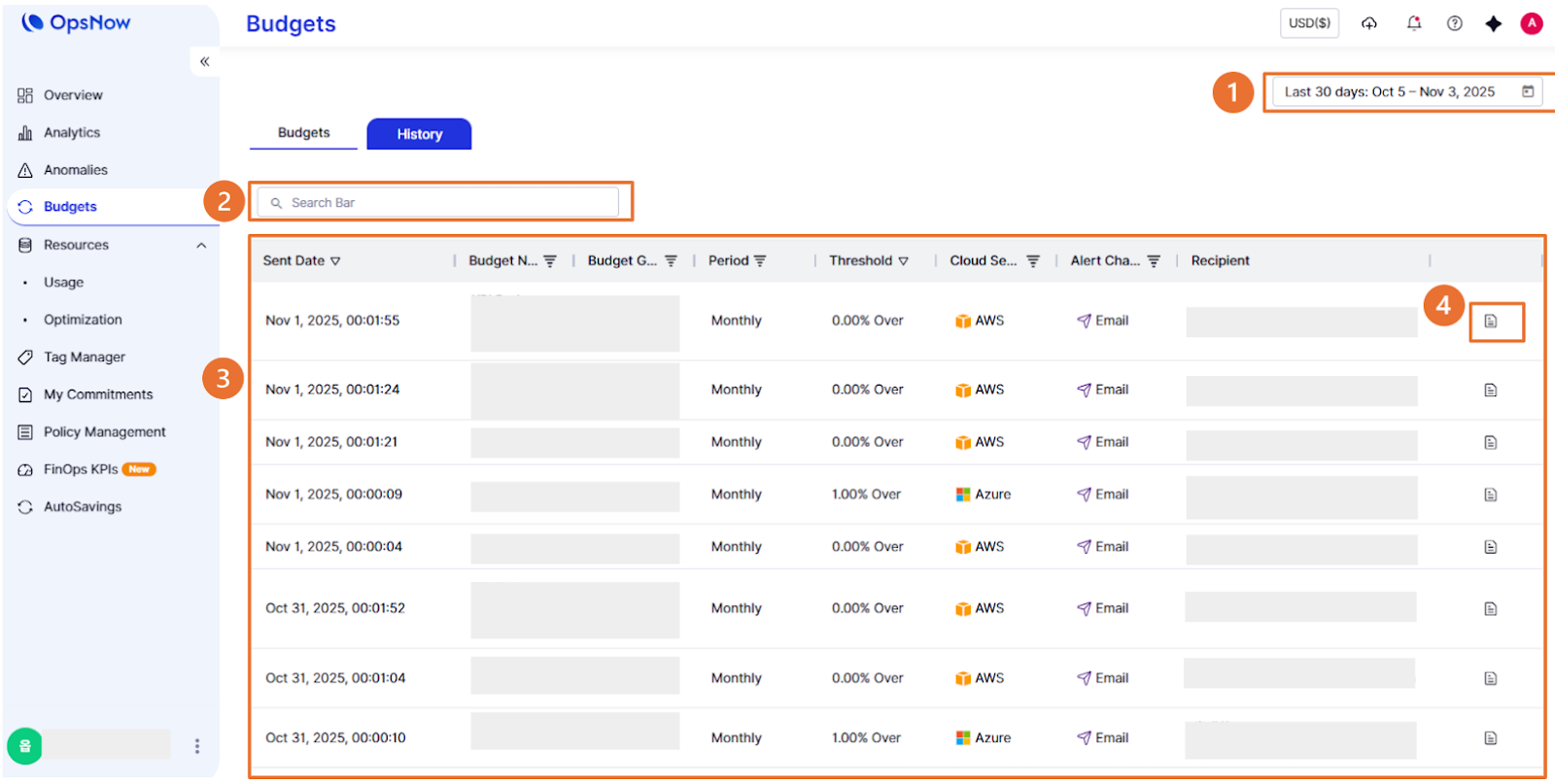
In **'History'**, you can view the notification delivery records, including when and under what conditions budget usage was detected, and which channels the alerts were sent through.
1. **Date Range Filter:** Located in the upper-right corner, this filter allows you to set the time period for the notification records you want to view.
2. **Search Bar:** You can use this search bar to find specific notification records by entering keywords, such as a budget name, group, or recipient.
3. **Table:** This table provides a detailed log of all sent alerts. You can check records for the set period, including:
* **Sent Date:** The timestamp (date and time) when the notification was dispatched.
* **Budget Name:** The identifier of the specific budget that triggered the alert.
* **Budget Group:** The defined group to which the budget is assigned.
* **Period:** The budget's configured time cycle (e.g., Monthly, Quarterly).
* **Threshold:** The specific condition (e.g., percentage over or under) that was met to trigger the notification.
* **Cloud Service Provider (CSP):** The cloud environment being monitored by the budget.
* **Alert Channel:** The configured delivery method for the notification.
* **Recipient:** The designated user or group that received the notification.
4. **Download Report:** This icon allows the user to download a detailed report that contains the budget information.
\